
The Liberia Anti-Corruption Commission (LACC) joined Government Officials, Members of the Judiciary, Civil Society Organizations, Development Partners, Legal Practitioners, and Anti-Corruption Advocates at the National Anti-Corruption Policy Dialogue Held
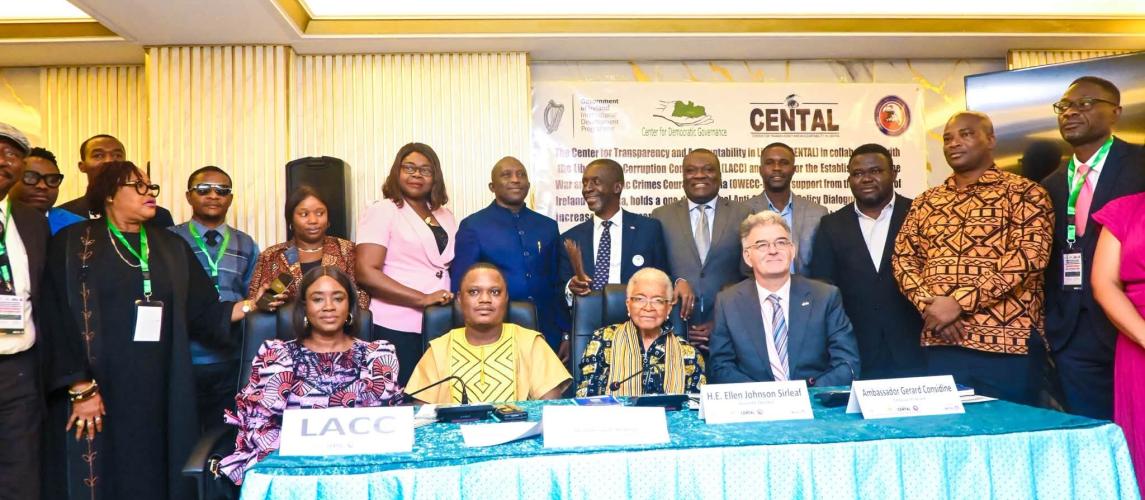
The Liberia Anti-Corruption Commission (LACC) joined Government Officials, Members of the Judiciary, Civil Society Organizations, Development Partners, Legal Practitioners, and Anti-Corruption Advocates at the National Anti-Corruption Policy Dialogue Held
Held under the theme, “Strengthening Transparency and Accountability in Liberia through the Establishment of the Specialized National Anti-Corruption Court,” the dialogue sought to build national consensus around the creation of a dedicated court to expedite the prosecution of corruption and corruption-related offenses as part of broader efforts to strengthen accountability and the rule of law in Liberia. The event was organized by the Center for Democratic Governance (CDG), the Center for Transparency and Accountability in Liberia (CENTAL), and Partners for Democratic Change, with support from the Government of Ireland.
Delivering the keynote address, former President Ellen Johnson Sirleaf emphasized that corruption remains one of the greatest obstacles to national development, undermining public trust, weakening institutions, and limiting economic progress. She stressed that the establishment of a Specialized National Anti-Corruption Court should be accompanied by genuine political commitment, strong institutions, and unwavering respect for the rule of law. She further encouraged Liberians to seize the opportunity to strengthen accountability mechanisms and ensure that corruption cases are handled effectively, fairly, and without undue delay, noting that sustainable development depends on credible institutions that inspire public confidence. (mfdp)
A panel discussion followed, featuring representatives from the Legislature, the Press Union of Liberia, the National Civil Society Council of Liberia, the Association of Female Lawyers of Liberia, and the Office for the Establishment of the War and Economic Crimes Court. Panelists discussed the legal, institutional, and operational considerations necessary for establishing an effective Specialized National Anti-Corruption Court.
Representing the Liberia Anti-Corruption Commission, Executive Chairperson Cllr. Alexandra K. Zoe delivered special remarks reaffirming the Commission’s support for the establishment of a Specialized National Anti-Corruption Court. She noted that a dedicated court would help expedite the adjudication of corruption cases and strengthen accountability. However, she stressed that its success will require sustained political will, judicial independence, adequate financial and logistical support, and qualified judicial personnel. Cllr. Zoe also underscored the importance of continued collaboration among integrity institutions, law enforcement agencies, civil society organizations, and development partners to ensure the proposed court effectively delivers on its mandate. She concluded by reaffirming the LACC’s commitment to working with stakeholders to advance reforms that strengthen Liberia’s integrity system and restore public confidence in the administration of justice.
