
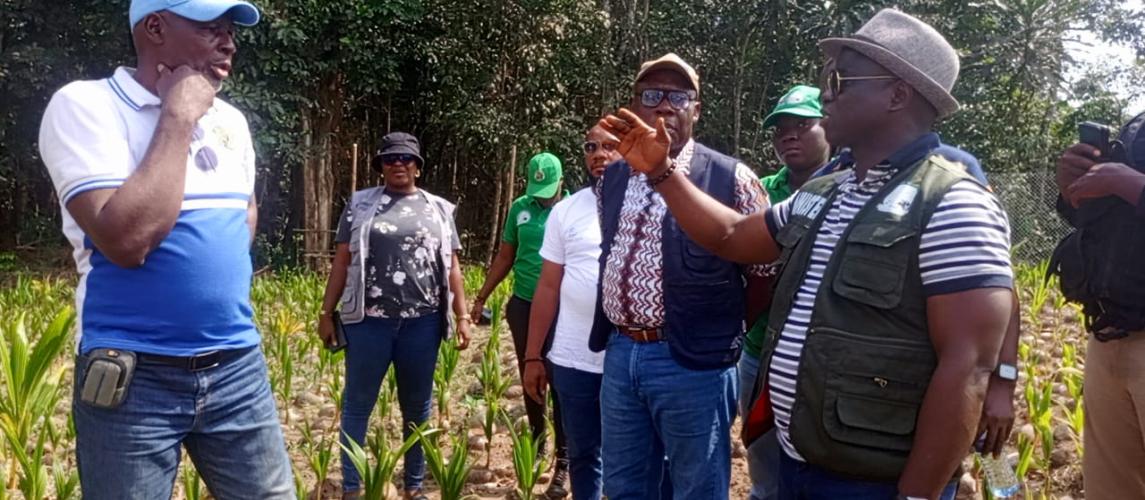

Sinoe County, March 11, 2026 – The Government of Liberia has announced a fully government-funded initiative to establish coconut seed gardens in four southeastern counties—Rivercess, Sinoe, Maryland, and Grand Kru— as part of a broader effort to expand tree crop production and strengthen rural livelihoods.
Agriculture Minister Dr. J. Alexander Nuetah announced a gathering with farmers and community members in Sinoe County, as part of his ongoing tour of the southeastern region to encourage increased agricultural production.
Under the initiative, the Ministry of Agriculture will identify and develop approximately 10 acres of land in each of the four counties to establish coconut seed gardens that will serve as a reliable source of improved coconut seeds and seedlings for farmers.
The Minister explained that the entirely government-funded project will be established on government-owned land, ensuring that the seed gardens remain a public resource dedicated to supporting farmers.
“The coconut seed gardens will be established on government land so that they remain a public resource. Once the trees begin producing, the seeds will be used to generate seedlings that will be distributed to farmers free of charge,” Minister Nuetah said.
To launch the initiative, the initial seedlings will come from Rivercess County, where the government has already established a dwarf coconut nursery. Seedlings from Rivercess will be transported to Sinoe County to begin developing the seed garden there before the program expands to the other counties.
Minister Nuetah noted that coconut presents significant economic potential for farmers in the southeastern region due to favorable soil and climate conditions.
“Under the One County, One Priority initiative, each county identifies crops with the greatest opportunity for growth and economic impact. In several southeastern counties, coconut production has the potential to become a major income-generating activity for farmers,” he said.
The coconut initiative is part of the government’s broader agricultural transformation strategy under the Liberians Feed Yourselves Agenda, which aims to increase domestic food production and reduce Liberia’s dependence on food imports.
While promoting tree crops such as coconut, Minister Nuetah emphasized that the government is also prioritizing rice production, Liberia’s staple food.
As part of this effort, the government is supporting farmers in Sinoe County to cultivate 100 hectares of lowland rice this year, providing assistance that includes land preparation, improved rice seeds, and basic farming tools.
This effort contributes to the national target of cultivating 50,000 hectares of rice across Liberia within the next five years, a key step toward strengthening food security and empowering Liberian farmers to produce more of what the country consumes.
“Rice is what we eat every day in Liberia, yet much of it is produced outside the country. We have the soil and the water to produce our own food, and the government is committed to supporting our farmers,” the Minister told the gathering.
Minister Nuetah stressed that strengthening both food crops and tree crops is essential to building a resilient agricultural sector—rice to ensure food security and crops like coconut to create income opportunities and stimulate rural economies.
During the visit, Minister Nuetah also toured rice farms and met with farmer groups involved in rice processing, where he encouraged them to expand production and strengthen local processing so that more Liberian-grown rice reaches local markets.
The Ministry of Agriculture continues to work with farmers and rural communities across the country to boost agricultural productivity, improve farmer livelihoods, and advance Liberia’s journey toward food self-sufficiency and sustainable economic growth.
