
President Boakai Demands Action Beyond Words on Slave Trade Reparations ~ Says, "History's Debt Remains Unpaid"
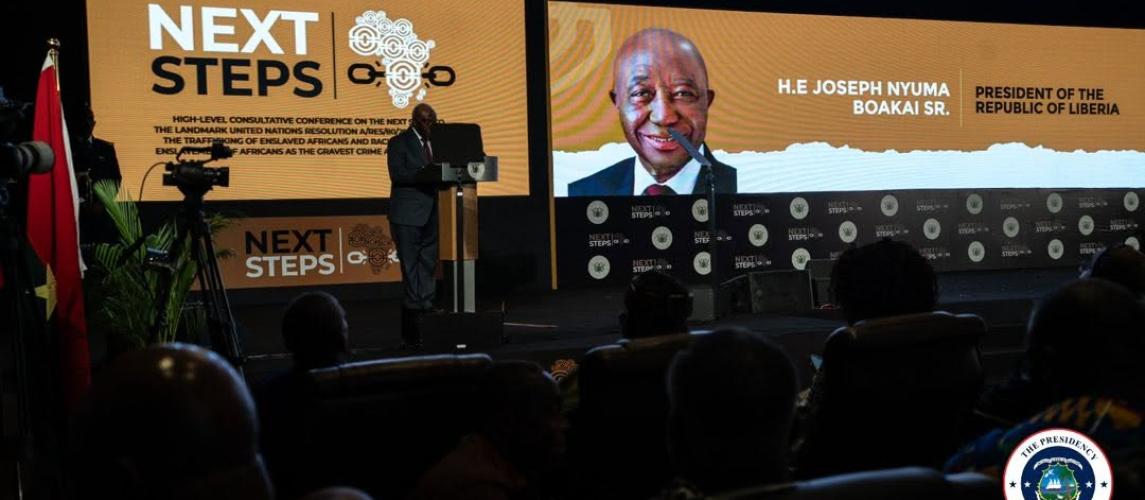
Delivering the keynote address on Thursday, June 18, 2026, at a two-day High-Level Consultative Conference on the implementation of United Nations Resolution A/RES/80/250 in Accra, Ghana, President Boakai said the world has reached a defining moment in its efforts to address one of humanity's gravest crimes.
The Liberian Leader maintained that the consequences of slavery extend far beyond history books, insisting that the transatlantic slave trade and its aftermath remain deeply connected to the economic and developmental disparities confronting Africa and the Global South today.
“There is no doubt that the slave trade and its aftermath contributed profoundly to inequality and underdevelopment in Africa and across the Global South. The past has helped shape the inequities of the present,” President Boakai declared.
Delivering the keynote speech at the Opening Ceremony of the Conference, popularly branded "Next Steps", that brought together African Heads of State, diplomats, development partners, civil society leaders, and representatives of the global African diaspora, President Boakai said the adoption of the UN resolution recognizing the trafficking and enslavement of Africans as among the gravest crimes against humanity must not be treated as a mere historical acknowledgment.
Instead, he urged governments and international institutions to pursue a comprehensive framework that includes truth-telling, reconciliation, cultural restoration, educational reform, institution-building, and development partnerships aimed at addressing the enduring effects of slavery.
The President proposed the establishment of an African Union–United Nations Expert Commission to design a Global Reparatory Justice Mechanism, stressing the need for stronger collaboration among African nations, CARICOM, and diaspora organizations to advance a common position on reparations.
President Boakai also advocated for the restitution of stolen cultural artifacts and expanded investments in historical research and education to counter what he described as misinformation and the erasure of Africa's history.
While acknowledging that the damages caused by slavery cannot be measured solely in financial terms, the Liberian Leader averred that centuries of forced labor, human trafficking, and resource extraction generated enormous wealth that helped shape the economic foundations of many societies around the world.
He challenged the global community to match its declarations with meaningful action. “Future generations will judge us not by the eloquence of our declarations, but by the courage of our actions,” he said.
The President further stressed that the pursuit of reparatory justice should not be viewed as an attempt to assign personal guilt to present generations but rather as a call for understanding, recognition, and collective responsibility in addressing the enduring legacy of historical injustice.
The Liberian Chief Executive concluded by urging world leaders to seize what he described as a rare opportunity to advance justice and reconciliation, warning against allowing the landmark UN resolution to become another forgotten commitment.
“Let this not be remembered as another conference or another resolution that stirred consciences briefly before fading into history,” Boakai warned, calling for “a determined global effort to restore dignity, repair historical wrongs, and build a future founded on equity, shared prosperity, and shared humanity.”
