
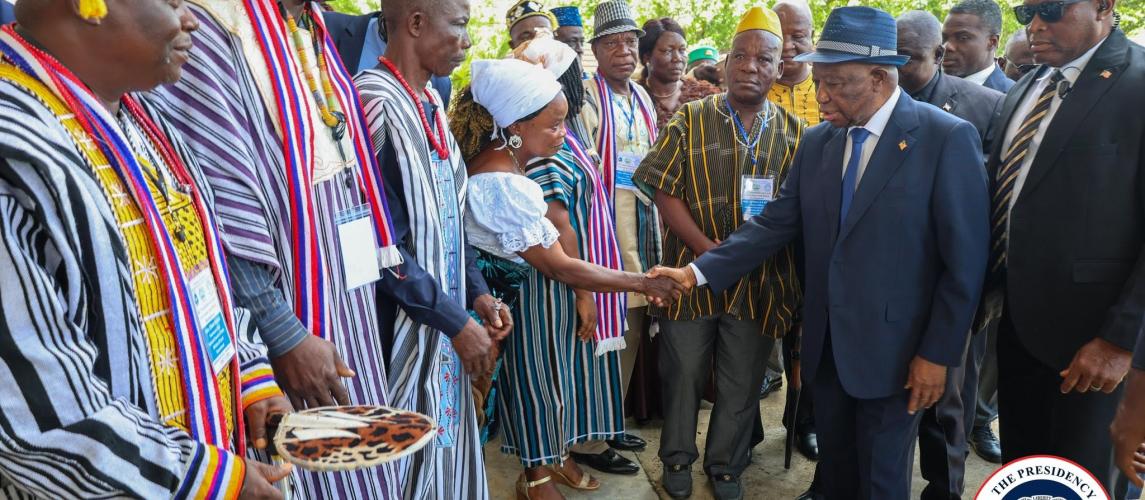
Speaking Monday at the opening of the First International Policy Roundtable on Local Governance and Rural Development in Harbel, Margibi County, President Boakai stressed that sustainable development cannot be driven solely from national capitals.
“Lasting progress must be anchored in strong local institutions, empowered communities, and responsive governance systems that bring decision-making closer to the people,” the President told policymakers, development partners, traditional leaders, and experts from Africa and Asia gathered at the Farmington Hotel.
Held under the theme, “Advancing Local Governance and Rural Development for an Inclusive and Prosperous Rural Future,” the roundtable aligns with the Government’s ARREST Agenda for Inclusive Development, which seeks to strengthen institutions, promote inclusive rural growth, improve service delivery, expand partnerships, and build resilient and accountable communities.
The conference brings together policymakers, development partners, and development practitioners from Africa and Asia to explore practical approaches to strengthening local governance systems and advancing rural transformation in Liberia and beyond. Participants are expected to share lessons from member countries of the African-Asian Rural Development Organization (AARDO), examine successful community-driven and agriculture-led development models, and identify strategies for strengthening local institutions in support of the ARREST Agenda.
Discussions will also focus on building institutional and human capacity for local governments, advancing fiscal decentralization, supporting policy reforms, and developing practical recommendations and an implementation roadmap aligned with Liberia’s development priorities.
President Boakai said the conference theme speaks directly to one of the most pressing challenges facing developing nations.
Reflecting on Liberia’s post-conflict experience, he emphasized the importance of inclusive governance and citizen participation in shaping sustainable development outcomes.
“The true measure of national development is found in whether ordinary citizens see improvements in their daily lives,” the President said. “It is measured by whether farmers can access markets, whether young people can find opportunities close to home, whether women are empowered to participate fully in decision-making, and whether communities have access to essential services and economic opportunities.”
President Boakai highlighted the ARREST Agenda for Inclusive Development as the Government’s principal framework for decentralizing opportunities and strengthening local governance nationwide. “This is why decentralization is at the heart of our development strategy,” he declared.
The President noted that the continued implementation of the Local Government Act of 2018 provides a critical framework for transferring authority and service-delivery responsibilities to local communities, helping bridge the gap between policymaking and the people.
He further emphasized that empowering local communities is essential to democratic governance and sustainable development.
“When communities are empowered to participate in planning, budgeting, implementation, and oversight, development becomes more responsive, transparent, and sustainable,” President Boakai said. “When local institutions function effectively, citizens gain confidence that government is working in their interests.”
The Liberian leader also pledged his Government’s full support for efforts aimed at establishing a West Africa Training Center for Local Governance and Rural Development in Liberia through collaboration with the African-Asian Rural Development Organization (AARDO).
Officially declaring the First International Policy Roundtable on Local Governance and Rural Development open, President Boakai called for stronger international cooperation to address shared development challenges, reminding participants that rural communities are not the periphery of development but its foundation.
“Development must move beyond policy discussions and become visible in the lives of our people. We must move development to the people,” President Boakai concluded.
