
PRESIDENT BOAKAI MOVES TO ESTABLISH NATIONAL MINING COMPANY AND GOLD REFINERY, SAYS “OUR MINERALS SHOULD SUPPORT DOMESTIC PROCESSING”
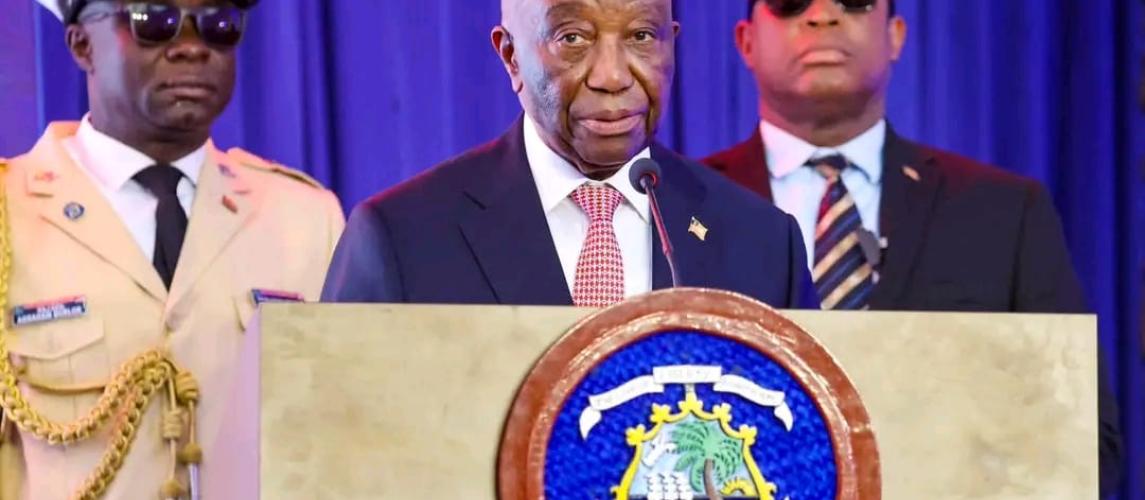
President Boakai made the disclosure Wednesday at the opening ceremony of the Liberia International Mining and Energy Conference and Expo (LIMEC 2026) at the Farmington Hotel, Harbel, in Margibi County. He said Liberia must move beyond exporting raw minerals while importing finished products, technology, and expertise.
“Our minerals should support domestic processing, industrial development, infrastructure, technology, and decent jobs,” President Boakai said, outlining his Administration’s vision for transforming the country’s mineral resources into lasting national wealth.
Held under the theme, “Transforming Liberia’s Economy: Driving Development Through Sustainable Mining and Energy Investment,” LIMEC 2026 seeks to attract local and international investment by showcasing Liberia’s mineral potential and strengthening partnerships among government institutions, investors, development partners, and technical experts.
The conference also aims to promote responsible mineral exploration, reliable geological data, infrastructure development, affordable electricity, and transparent regulatory frameworks. Its broader objectives include securing practical investment commitments, creating jobs, developing local skills, strengthening Liberian businesses, expanding domestic mineral processing, and advancing renewable energy, multi-user railway infrastructure
President Boakai said the proposed National Mining Company would enable the Government to participate more actively in the sector through equity and strategic ownership rather than relying solely on royalties from mining operations. Together with the planned gold processing facility, the initiative is expected to support economic diversification, increase government revenue, and improve living standards.
He said the gold processing facility, expected to be established within two years, aligns with the African Minerals Strategy Group’s call for value addition before minerals leave the continent. He noted that the Government’s intent is for gold extracted in Liberia to undergo primary and secondary refining at licensed domestic facilities to internationally recognized purity standards before export, retaining more economic value locally and creating skilled employment opportunities.
The President also issued an authorization for the setup of a Liberia Sovereign Wealth Fund, intended to operate as an independent investment vehicle in accordance with the international Santiago Principles. The fund would channel a fixed percentage of mineral revenues into diversified domestic and international investments to preserve wealth for future generations and reduce exposure to commodity-market fluctuations.
To improve knowledge of Liberia’s mineral resources, President Boakai said the Government will undertake geological mapping, improving mineral information management, and expanding access to technical data through a coordinated national exploration program over the next five years.
The Liberian Leader went on to disclose plans for a US$30 million airborne geophysics data collection initiative under the Millennium Challenge Corporation compact to improve understanding of the country’s critical and strategic mineral resources and reduce exploration risks for investors.
The President further said the government would review the Minerals and Mining Law and related regulations, strengthen mineral-rights administration and licensing, improve digital systems, and enhance oversight of mining operators. He emphasized that Liberia’s mineral wealth must generate greater domestic value, responsible investment, and lasting economic benefits as the country pursues its development objectives through 2030 and beyond.
Addressing the Conference, the sector minister, Mines and Energy Minister, Honorable R. Matenokay Tingban, highlighted additional measures to strengthen mineral governance, improve geological information, and attract responsible investment. He said more than 80 percent of Liberia remains unexplored, underscoring the importance of reliable geological data in guiding exploration, reducing investment risks, and improving negotiations with prospective investors. “Our position is clear: no data, no deal,” Minister Tingban remarked.
The sector Minister went on to highlight the issue of Liberia’s artisanal and small-scale mining formalization initiative, which he noted seeks to improve licensing, promote cooperative development, strengthen occupational safety and environmental protection, expand miners’ access to equipment, financing, and legitimate markets. The initiative, the Minister foresees, will give particular attention to women, young people, and communities dependent on small-scale mining.
Minister Tingban urged conference participants to move beyond expressions of interest and pursue concrete projects with clear responsibilities and realistic implementation timelines. He said the conference’s success should be measured by the partnerships established, investments advanced, jobs and skills created, and improvements in the lives of Liberians. He also called on investors to respect Liberia’s laws, protect the environment, and support national development priorities.
Also addressing the Conference were the Chinese Ambassador to Liberia, His Excellency Yin Chengwu, and United States Chargé d’Affaires, Her Excellency Kristin Gilmore. Both foreign envoys reaffirmed their respective country’s support for Liberia’s mining and energy development, emphasizing investment, infrastructure, technical cooperation, and local value addition.
Ambassador Chengwu outlined four priority areas for China-Liberia cooperation: mineral governance and technical capacity building, mining investment, renewable energy development, and sustainable mining practices.
The Ambassador said Chinese iron ore projects had created more than 500 jobs for Liberians and supported infrastructure development, including roads and port facilities.
He added that China was prepared to share expertise in geological surveys, resource assessment, and mining skills training while exploring sustainable financing arrangements and technology transfer to strengthen Liberia’s domestic mining value chain.
U.S. Chargé d’Affaires Gilmore highlighted the Millennium Challenge Corporation’s ongoing development of a second compact for Liberia, focusing on mining and electricity sector reforms to unlock private investment and promote long-term economic growth. “The United States Government is proud to support this effort,” the U.S. Diplomat declared.
She added that the U.S. Trade and Development Agency was finalizing a grant to assess Liberia’s railway infrastructure in support of President Boakai’s vision for a multi-user rail system, describing rail infrastructure as important to opportunities in the minerals and agricultural sectors.
Her Excellency furthered that investors needed “transparent and predictable rules, fair access to infrastructure, and an electricity sector that welcomes private investment.” She then assured that the United States was prepared to work with the Liberian Government to translate reform commitments into tangible development results.
