
PRESIDENT BOAKAI SIGNS HISTORIC PEACE MUSEUM CHARTER AHEAD OF MONDAY’S NATIONAL STEERING COMMITTEE INAUGURATION AS DELEGATIONS FROM RWANDA AND SOUTH AFRICA PREPARE TO ARRIVE
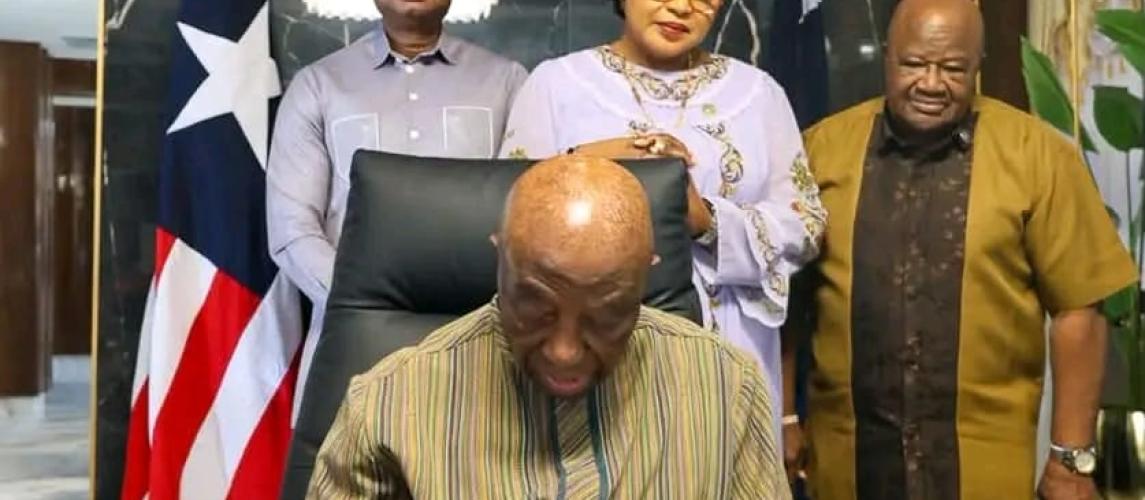
President Boakai is set to preside over Monday’s opening session of the inaugural National Steering Committee meeting, which runs from November 16 to 18 at the Executive Pavilion in Monrovia. Technical delegations from Rwanda and South Africa are expected to arrive between November 14 and 15 to join the Government of Liberia, the United Nations Development Programme (UNDP), national stakeholders and development partners.
The Liberian Chief Executive signed the Charter alongside the Minister of State without Portfolio, Honorable Hadja Mamaka Bility, who chairs the Steering Committee, and UNDP Resident Representative Ambassador Aliou Mamadou Dia, who serves as co-chair. The Charter sets out the Museum’s mandate, leadership, governance and decision-making procedures. It establishes five technical working groups covering the national narrative, archives and collections, governance and legal framework, design and visitor experience, and education and public engagement.
“Liberia cannot build a united future on a past it refuses to remember,” President Boakai remarked, pointing out that, “This Museum will keep the memory of what we endured alive, honor those we lost, and teach our children that peace is a choice we must make every day.”
For her part, Minister Bility reminded Liberians that, “Today we have put our names to a promise,” adding “remembering our past and building a united future is the work of this Museum, and this belongs to every Liberian.”
In his remarks, Ambassador Dia thanked President Boakai for entrusting UNDP with co-chairing the Committee and supporting the Museum’s design and development. He described the Project as an opportunity to preserve Liberia’s collective memory and inspire future generations to protect the peace.
The visiting experts bring experience in historical preservation, museum development, memorialization, reconciliation, and post-conflict recovery. Their participation builds on a UNDP-supported study mission in Southern Africa, led by Minister Bility between August and September 2026. In Rwanda, the Liberian delegation visited the Gacaca Archives and the Campaign Against Genocide Museum to learn how the country documents the 1994 Genocide against the Tutsi. In South Africa, the Apartheid Museum and Freedom Park were visited. Engaging the delegation, South Africa’s Minister of Sport, Arts and Culture, Gayton McKenzie, pledged technical support for Liberia’s Project.
With UNDP’s support, the Steering Committee will provide strategic guidance and coordinate participation as the Project moves toward implementation.
The three-day meeting will address archives management, institutional partnerships, museum design, public education and the steps toward construction. Historians, researchers, educators, civil society organizations, survivors, young people, and affected communities are expected to contribute to the museum’s development.
The Museum forms part of President Boakai’s National Historical Recovery Initiative, launched earlier in July 2026 during Liberia’s 179th Independence Day celebrations in Buchanan, Grand Bassa County. The initiative seeks to recover historical records, including copies of materials held abroad, and put Liberians at the center of documenting and telling their history. The museum is expected to collect, verify, preserve and digitize photographs, government records, audiovisual materials and survivor testimonies.
The Project follows President Boakai’s public apology on behalf of the Liberian State to victims and families affected by the civil wars. The conflicts, which lasted from 1989 to 2003, claimed an estimated 250,000 lives, displaced hundreds of thousands and caused widespread destruction.
