
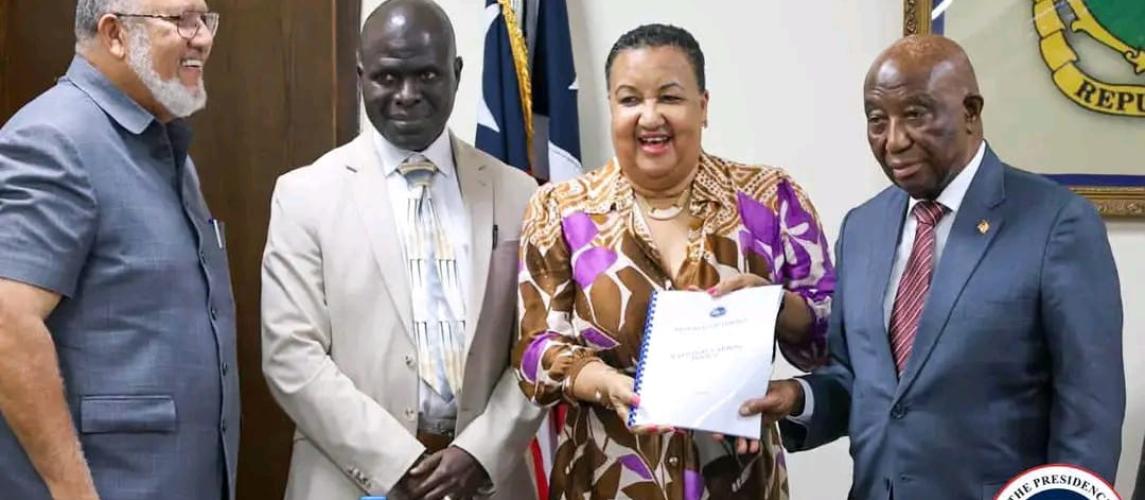
The policy emerged from an extensive national consultation and consensus-building process involving forest-dependent communities, civil society organizations, government institutions, the Environmental Protection Agency (EPA), and members of the Legislature.
It establishes a national framework to guide Liberia’s participation in the rapidly evolving global carbon economy, including the roles and responsibilities of government institutions in carbon-market activities and climate finance.
The policy is also intended to ensure that Liberia’s engagement in the carbon economy is guided by national interests, transparency, and broad stakeholder participation.
Receiving the policy document, President Boakai commended the extensive consultations and technical work that led to the consensus, describing the process as a reflection of a shared commitment to Liberia’s future.
The President said the policy provides an important foundation for ensuring that Liberia’s forests, which play a critical role in absorbing carbon and addressing climate change, generate meaningful benefits for the country and the communities that live alongside and help protect them.
President Boakai stressed that Liberia must find ways to ensure that its natural resources create tangible benefits for its people, particularly forest communities that have historically depended on and protected the country’s forests.
He said the development of a national carbon policy could provide a more structured pathway for Liberia to attract climate finance, participate in carbon-market transactions, and support conservation and climate-related development initiatives.
The Liberian Leader also called for greater confidence in Liberian expertise, noting that the country has capable professionals who, when given the opportunity and responsibility, can make meaningful contributions to national development.
He cautioned against allowing prolonged discussions to delay action, stressing that while the policy can be reviewed and improved over time, Liberia must begin with an agreed-upon framework.
“There are amendments we will make, but we have to have something done for now, and that’s what we have to do,” the President pointed out.
President Boakai particularly acknowledged the Environmental Protection Agency and the technical team that contributed to the development of the policy, describing their efforts as evidence of Liberia’s growing capacity to address complex national and international issues.
The President further emphasized that national decision-making requires leaders to act in the best interest of the country, even when it may not be possible to satisfy every individual or stakeholder.
He noted that those entrusted with leadership must make decisions based on what they believe is right and beneficial for Liberia.
The National Carbon Policy is expected to serve as a foundation for Liberia’s future engagement with carbon markets and climate finance, while strengthening national
